The J's Store is a Lahore brand making custom leather shoes — mostly Italian suede, with a focus on sizes the market ignores, up to 48–49. Aseez Jamal, a computer-science lecturer turned shoemaker, came on Ecommerce Baithak to explain how a family business that started with belts and wallets became a premium footwear brand with more than 5,000 active customers in about 18 months.
What makes this case study unusual is that it is not about managing the problems every Pakistani eCommerce brand complains about — returns, cash on delivery, couriers. It is about changing the product and the promise so those problems mostly never arise. Figures are as stated on the show and unaudited.
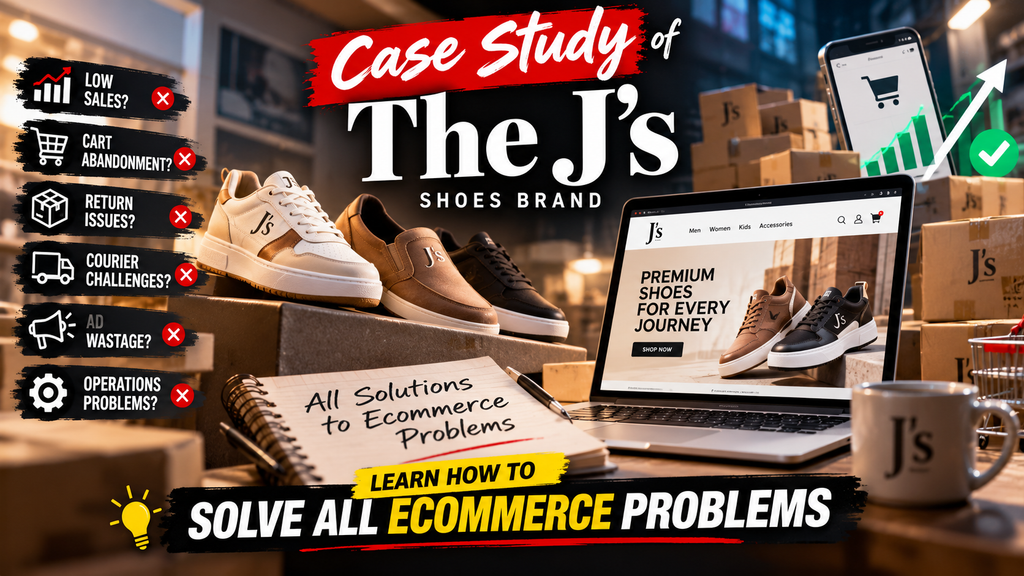
The short version
Find your biggest cost drivers — returns, courier failures, acquisition discounts — and redesign the product or promise so they cannot happen. Measuring every foot removes wrong-size returns. Trust-based payment removes no-commitment orders. Paying riders directly removes failed attempts. Then charge for the service.
From a refused visa to a shoe factory
Two of the brothers had planned a restaurant in Australia and were refused visas. The four brothers built a business in Pakistan instead, starting with leather belts, wallets and watch straps. Aseez taught by day and learned manufacturing in a factory in the evening. By late 2023 it was clear accessories could not support the family, so they pivoted to shoes — Aseez went to Lahore's Anarkali market to learn the craft — and moved production from Bahawalnagar to Lahore, where leather, buckles and skilled labour were easier to find. Wholesale customers paid late, which pushed them to build their own brand.
Price follows product
A pair that sold for about Rs 6,000 now sells for Rs 12,000–13,000, with an average order around Rs 15,000. The jump did not come from advertising. It came from better quality control and better packaging — a box, butter paper, a thank-you card and a next-order discount card. About 30 per cent of customers say they used to pay far more elsewhere; one said a comparable pair had cost him Rs 40,000.
Aseez's view on price is the one I share with most premium founders: if a customer cannot find the same shoe in their size, design or leather anywhere else, price stops being the deciding factor.
Fit as a service
A designer visits the customer at home or at the office, measures both feet, advises on size and records the session. Customers outside Lahore are measured on video; some busy clients pay the designer's travel. During production, customers get WhatsApp photos at each stage and a short reel of how their shoes were made. The brand stocks 40–50 suede colours.
Large sizes are a genuine moat. Regular big sizes are 46–47; The J's Store makes up to 48–49 and charges a Rs 2,000 surcharge for urgent delivery, which customers pay without complaint. One family ordered two pairs, received them in three days, and immediately ordered six more for their sons. Customisation is messy on the factory floor — single-size runs, missing materials that cost a day — but the founders treat that as part of the product.
Speed and the abandoned checkout
The marketing team generates leads; the founders handle the conversations. A customer ordering at 3 a.m. received a call within about 30 seconds. The founders also call abandoned checkouts themselves: of ten in a day, they typically reach about seven, and about three of those convert. At a Rs 15,000 ticket, that is the best-paid phone call in the business.
Zero-amount parcels and the COD question
For trusted or hesitant customers, The J's Store ships a parcel with no advance and no cash on delivery. The customer tries the shoes and transfers payment afterwards. Out of more than 5,000 customers, two have never paid — and twice a customer returned an old pair instead of the new one.
There is also a cash-flow reason. COD receipts carry a 4 per cent tax that bank transfer avoids, and COD money that takes about ten days to arrive comes in around three days by transfer. Returns sit at 10–12 per cent, and most of those are failed deliveries where the customer was not home — not wrong sizes, and not cold feet.
To be clear about the limits: zero-amount delivery works at low volume and high ticket value. It would be impractical at thousands of parcels a day.
Paying the last mile directly
Couriers earn very little per parcel, so riders have little reason to try twice. The J's Store pays riders Rs 300–500 by mobile wallet for two extra doorstep checks, connects rider and customer directly, and has the customer try the shoes with the rider present. When a Sargodha customer's sole partly came loose on first wear, the founder paid a rider Rs 300 to take the pair to a repair shop, filmed the repair, and had it back by 8 a.m. the next day. On some routes, parcels go by intercity bus and arrive in hours. At Rs 15,000 a parcel, Rs 300 is cheap insurance.
Customers for life
Aseez regularly asks his team for the last two months of customers and calls them himself for feedback. One customer had given his shoes to his driver because the experience was so poor; after a voice note and a 15-minute conversation, he placed a Rs 50,000 order. The brand now runs a complaint system where every complaint has a number, an owner, a department and a resolution time.
Retention tactics are simple and deliberate: the best discounts go to existing customers, every box includes a 15 per cent next-order card, dead sizes are cleared by phone at steep discounts, Lahore customers can visit the factory for 50 per cent off a pair that fits, and a team member can bring five pairs to a customer's door. Rarely does more than one come back. Marketing spend was Rs 7–8 million last year, and reducing it is a stated goal — retention is how.
The Rs 7 lakh-a-day hack
In 2025 the brand's Meta ad account, shared by link with six or seven people, was compromised. The attacker ran ads at about Rs 7 lakh a day on a card owned by Aseez's elder brother in the UK — who approved the charges, assuming the business was growing. Two payments went through before anyone understood. Normal daily spend, by our arithmetic, was around Rs 19,000–22,000, so the attacker was spending 32–36 times more.
Aseez removed everyone's access, built an in-house dashboard so the team can see spend without admin rights, and reviews ad numbers daily. The security checklist we gave on the show applies to every brand:
- Use a separate email for your Meta account.
- Turn on authenticator-app two-factor login for Gmail, Facebook, Instagram and WhatsApp Business.
- Use 16–18 character passwords.
- Run ads from an identity separate from your personal one, and verify the business with ID.
- Share numbers through dashboards, not admin access.
- Vet every third-party connector — including AI and MCP tools — before linking an ad account.
The Joker shoe
A Spanish customer ordered a custom design, paid Rs 25,000 of Rs 30,000 upfront, and had a flight on 27 October. By the 20th the courier claimed he was refusing the parcel. Aseez called, learned otherwise, made a new pair immediately and shipped it by TCS in time. The original came back 15 days later. The team photographed it during a new shoot and listed it at Rs 20,000 — and orders started that night. The brand now makes five to eight pairs a day of that design. A logistics failure became the biggest talking point in the brand's history because the team treated returned stock as content, not dead inventory.
What transfers to your business
- Upgrade packaging and quality before raising prices.
- Own the sizes or specifications nobody else serves.
- Make fit a service — measure before you make.
- Reply to orders in minutes, and call high-ticket abandoned checkouts yourself.
- Use trust-based payment only where ticket size is high and volume is manageable.
- Pay riders directly for extra doorstep checks.
- Give existing customers your best deals and a next-order card in every box.
- Lock down ad access: separate identities, two-factor login, dashboards instead of master access.
Returns and COD are not fixed problems you have to live with — they are design decisions. Working through them with brands is the core of what I do as an eCommerce consultant in Pakistan.