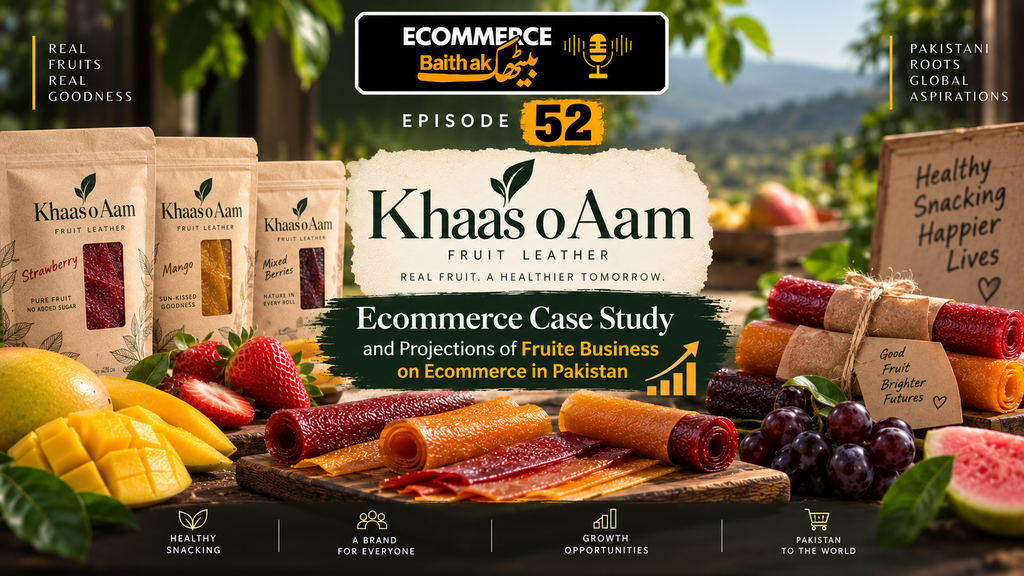
Fruit leather is dried, puréed fruit pressed into sheets, strips or bites. In Pakistan most people know it as aam papad. It sits squarely on several global trends at once — clean-label, lower-sugar, shelf-stable snacking — and it needs very little capital equipment to make, which makes it unusually well suited to small-batch eCommerce.
Khasoaam.com, based in Rawalpindi near Punjab's Chaunsa mango belt, is the Pakistani brand doing it online. No founder is named publicly, and the brand's financials are not disclosed — so the unit economics below are a benchmark-based model, not reported figures.
The short version
The supply is there, the global category is growing, and Khasoaam's merchandising is smart. Its biggest leak is not marketing — it is stock-outs on the flagship product. Fix capacity, push prepaid, add a subscription, then follow the mango export corridor abroad.
The global market
Estimates vary because some research houses confuse fruit leather with bio-based "vegan leather" materials. Taking the credible ones together, the category is worth roughly $1.2–2.8 billion, growing 7–10 per cent a year. North America is the largest region, around 38 per cent. Asia Pacific is about $305 million and the fastest-growing. Europe is second-largest, and the EU's 2026 front-of-pack labelling rules should favour clean-label snacks. Online is gaining share — from around 14 per cent of sales in 2022 to an estimated 20 per cent in 2026.
Pakistan's supply advantage
Pakistan is the sixth-largest mango producer and fourth-largest exporter, growing roughly 1.4–1.8 million tonnes a year. Only about 6–7 per cent is exported — around 135,000 tonnes worth about $119 million in 2024, three-quarters of it to the GCC. In February 2026 the first direct mango shipment, 120 tonnes, reached the Netherlands after EU approval. Mango, plum, peach, guava and falsa are all grown commercially. The constraint on input is climate and water, not scarcity. Value-adding even a small share of the unexported crop is a real opportunity.
What Khasoaam does well
The store runs on Shopify with Shopify Payments and more than 50 SKUs in two lines: Fruity Bites in nine flavours across 40g, 80g and 100g pouches, and Fruity Roll sheets. Pouches run from Rs 300 to Rs 700 and roll sheets from Rs 1,000 to Rs 1,800. Delivery is nationwide in three to five working days, and the brand claims more than a million customers over five years.
The merchandising is the best part:
- Bundles solve the courier problem. A Rs 350 pouch cannot carry a courier fee. Packs of 4, 6 and 8 — or 5, 10 and 15 for small pouches — with 5–10 per cent off can. The pack of six is flagged "Most Popular".
- The free-shipping threshold, Rs 2,200, sits just below the entry bundle, nudging customers up a size.
- Flavours speak to local taste — Guava Chilli and Mango Tamarind Spicy tap the South Asian appetite for chatpata.
- The origin story — orchards, direct from farmers — does the trust work.
The gaps
The flagship Fruity Roll SKUs are repeatedly out of stock. That points to a drying-capacity or working-capital bottleneck, and it is very likely the single biggest revenue leak in the business. Two further gaps: there is no export checkout — prices are PKR-only with domestic policies — and there is no subscription, despite a natural 30–45 day consumption cycle.
Modelled unit economics
Using 2025 Pakistani benchmarks — add-to-cart around 9.5–10 per cent, cart abandonment around 72 per cent, about 75 per cent of payments by COD and 80 per cent of shoppers on mobile — every 100,000 visitors yields roughly 9,800 add-to-carts, 2,744 checkouts and about 2,330 confirmed orders: a 2.3 per cent conversion rate.
At an average order around Rs 2,800, that is about Rs 6.5 million a month, or an annual run-rate near Rs 78 million. After COGS (30–38 per cent), courier and fulfilment (8–12), COD failures and returns (3–6), paid marketing on Meta, TikTok and Google (15–25) and platform fees (2–3), contribution margin lands around 29.5 per cent — roughly Rs 23 million a year for overheads, team and reinvestment.
Ranked by payback, the priorities are:
- Fix Fruity Roll stock-outs — potentially 15–20 per cent of revenue.
- Shift customers from COD to prepaid, which can lift realised revenue 3–5 per cent for every ten points of shift.
- Add a 45-day auto-reorder subscription; even 10 per cent uptake changes the model.
- Open export and diaspora markets.
Going global: follow the corridor
The mistake would be to compete cold against Western snack brands. The better route follows the corridor Pakistani mango already travels: the UAE and GCC, where three-quarters of mango exports go and the diaspora is large; the UK, with an established diaspora; Saudi Arabia, with strong halal and clean-label demand; North America, the largest fruit-leather market; and the EU, newly open after the 2026 direct shipment. Capturing even 0.05–0.1 per cent of the global category within three to five years implies $600,000 to $2.8 million in additional revenue.
What transfers to your business
- Value-add the surplus: Pakistan's unexported produce is a raw-material advantage.
- Bundle low-ticket products until the order can carry the courier cost.
- Set the free-shipping threshold just below your most popular bundle.
- Fix stock-outs before you spend more on ads.
- Consumables need a subscription.
- Export along existing diaspora and trade corridors first.
Taking a Pakistani product abroad is a different business from selling it at home — pricing, payments, compliance and logistics all change. That is the work I do on cross-border eCommerce, and for brands targeting the UK, USA and Canada.