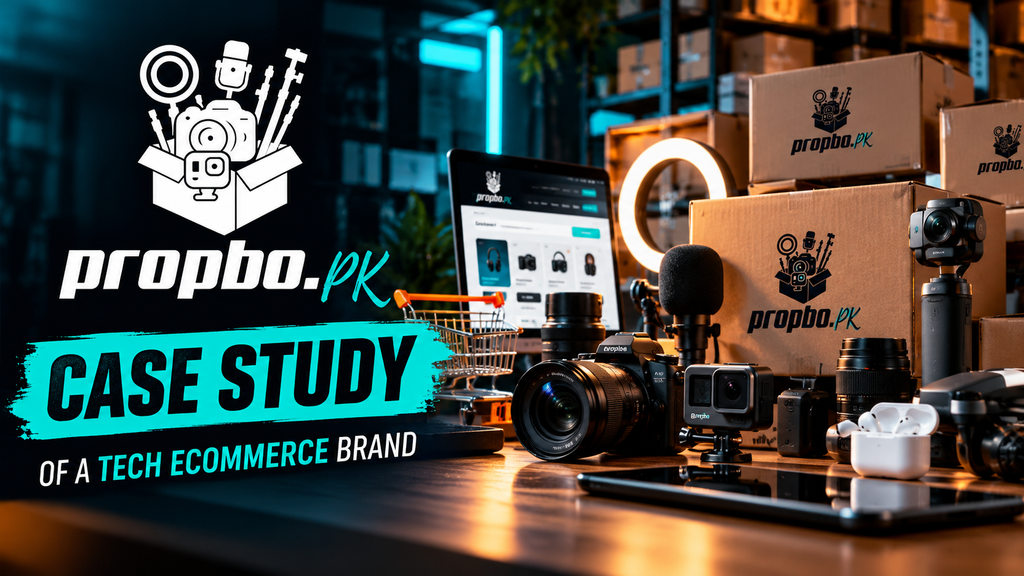
Probo.pk is a small Pakistani store selling lights, tripods, microphones and studio kits to content creators. Its founder, Hasnain, has worked in property since 2015 and in eCommerce since 2020. Before Probo, he had two businesses fail. He came on Ecommerce Baithak Episode 55 to talk about both — and about the operational traps that make electronics one of the hardest categories to sell online in Pakistan.
His figures are his own and unaudited. Where it helps, I have set them against outside data.
The short version
Pick a category with proven demand, count sourcing time as a cost, sell to buyers who keep coming back, and design checkout, packaging and pricing around the losses you know are coming — fake returns, courier grey areas and damaged stock.
Two failures, and what they cost
The first venture was nightwear. Around six months went into searching for fabric, with imported quotes coming in at Rs 160 against Rs 250 locally. The second was makeup palettes: roughly Rs 2 lakh of goods met a customs demand of about Rs 2.6 lakh and sat stuck at the airport.
Two lessons came out of that, and I would put them in front of every new importer. First, search time is a cost even when no money changes hands. Second, get the full landed cost — duty, tax and clearance — in writing before you pay a supplier.
Why gadgets, and why creators
Consumer electronics is one of eCommerce's biggest categories — around $690 billion globally in 2025 — and electronics is roughly 23 per cent of Pakistan's online revenue. Demand is proven. The founder's sharper decision was the customer. He describes it as selling nets, not fish: content creators keep buying as they upgrade, and new creators keep arriving. With TikTok's adult ad reach in Pakistan near 80 million at the end of 2025, that pipeline is not running dry.
Sourcing: the Hall Road diary
He walked Lahore's Hall Road shop to shop with a diary and a pencil, writing down every price. Then he used a trick I have heard from very few sellers: ask the neighbour. A shop selling microphones will not tell you where its microphones come from — but it will happily tell you who supplies the lights next door. Follow that chain upward until you reach the wholesaler or importer.
The first launch was deliberately small: a three-day course, a small batch and one ad. That ad sold out about Rs 78,000 of stock and brought around Rs 1.75 lakh in sales. It did not prove the business would scale. It proved somebody would buy — which is the only question a first ad needs to answer.
Trust and checkout
Pakistan's cart abandonment sits around 71.5–72 per cent, close to the global average, and about 70 per cent of shoppers still prefer cash on delivery. Probo's response was counter-intuitive: make checkout stricter. It asks for a full address and a small advance payment, with a guide video right on the checkout page. By the founder's account, orders did not drop — the step filtered out buyers who would never have accepted the parcel.
The ads are built on honesty: say what a cheap mic cannot do, sell studio packages rather than loose items, and shoot zoomed-out creative that shows the whole setup. In a category full of overpromising, telling the truth is a differentiator.
Returns: the onion in the parcel
Probo used to allow open-parcel delivery. That ended when a parcel came back with an onion where the microphone should have been. Tech is hard to resell once opened, so a bad return is pure loss — and DHL puts Pakistan's return-to-origin rate at 18–20 per cent.
The fix is cheap and clever: a recording sticker on every parcel asking the customer to start a video before opening it. Breakages are replaced on video proof. The founder estimates about 90 per cent of returns originate on the customer side — his experience, not an industry statistic. One night brought fifteen complaints about a microphone that simply had not been switched on.
He also described "quiet returns": riders allegedly paid around Rs 1,000 a month to send parcels back without a delivery attempt. His proposal for couriers is three technologies — an in-app dialer with recorded calls, a gate photo as proof of attempt, and one live tracking view shared by customer, seller, courier and rider. His argument is that these stay off because they would end the grey areas. Couriers would point to scale and cost. Both can be true.
The 3x rule
His pricing formula is simple: sell at three times cost, and think of the price in thirds — one third for the purchase, one third for damages and losses, one third for ads, packaging, courier, salaries and profit. That implies a 66.7 per cent gross margin, far above the 15–30 per cent typical for electronics. It only works because Probo sells bundles and setups rather than commodity SKUs that customers can price-check on Daraz in ten seconds.
What transfers to your business
- Get landed cost in writing before paying any supplier.
- Ask the neighbour, not the competitor, to find wholesalers.
- Start with one small batch and one ad. Prove demand before you scale.
- Sell to buyers who repeat — creators, not one-off gift buyers.
- Let checkout filter buyers: full address, small advance, guide video.
- Put a recording sticker on every high-value parcel.
- Price for the losses you know are coming, not the ones you hope to avoid.
Returns, COD and courier leakage are the three things that most often turn a profitable-looking store into a loss-making one. They are also what my team at SmartReturns and Deployers works on every day. If your numbers look good before delivery and bad after it, let's talk.